2. Methods
MSD Technology:
MSD’s electrochemiluminescence detection technology uses SULFO-TAG labels that emit light upon electrochemical stimulation initiated at the electrode surfaces of MULTI-ARRAY and MULTI-SPOT microplates.
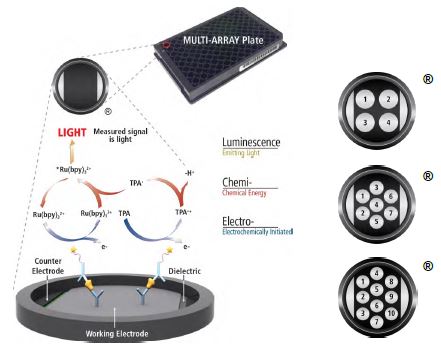
Electrochemiluminescence Technology
- Minimal non-specific background and strong responses to analyte yield high signal-to-background ratios.
-
The stimulation mechanism (electricity) is decoupled from the response (light signal), minimizing matrix interference.
- Only labels bound near the electrode surface are excited, enabling non-washed assays.
- Labels are stable, non-radioactive, and directly conjugated to biological molecules.
- Emission at ~620 nm eliminates problems with color quenching.
- Multiple rounds of label excitation and emission enhance light levels and improve sensitivity.
- Carbon electrode surface has 10X greater binding capacity than polystyrene wells.
- Surface coatings can be customized.
SNP detection with OLA and N-PLEX:
The oligonucleotide ligation assay (OLA) used probes that were specific for DNA sequences upstream and downstream of the SNP of interest, with only exact matches at the SNP site allowing for the ligation of the two probes. The ligated probes were hybridized to spot-specific capture oligos on the N-PLEX plates to allow for detection.
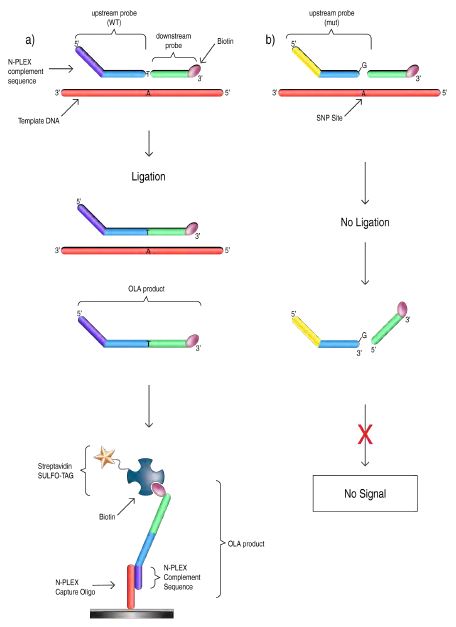
SNP Detection
- Each well in an N-PLEX 96-well plate has an array of 10 unique capture oligos attached to the surface of the plate, allowing for the detection of up to five SNPs per well. Three probes were needed per target: a biotinylated
-
(downstream) probe and two (upstream) probes that recognized either polymorphic base and contained a sequence complementary to a specific capture oligo. Probe characteristics: 17-33 nucleotides in length; optimal probe ligation temperatures between 62-67 °C for a given pair.
- Taq DNA ligase was used to join upstream and downstream probes that aligned correctly on a given DNA sample. Fragments of unmodified template complements were added to prevent bridging of unligated probes.
-
OLA products (from synthetic oligos or PCR products from DNA samples) were hybridized to the appropriate capture oligo on the N-PLEX plate, bound by SULFO-TAG labeled streptavidin, and analyzed using an MSD instrument.
- Synthetic oligos were obtained from IDT
- Blood samples were obtained from BioIVT and DNA was extracted using the QIAamp DNA Blood Mini Kit (Qiagen).
- DNA was extracted from the HL-60 cell line using the PureGene Cell and Tissue Kit (Qiagen).
- For concordance, SNP determination for three SNPs was compared with Taqman SNP Genotyping Assays (Thermo Fisher Scientific), using manufacturer’s guidelines.
3. Selected SNPs
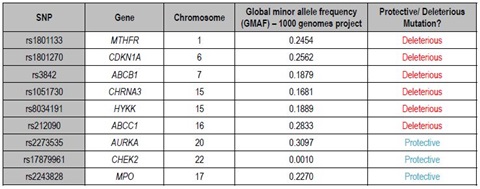
SNPs that have been shown to be genetic risk factors (either protective or deleterious) for lung cancer development were chosen that were 1) well-distributed throughout the human genome and 2) well-represented in the general population for the majority of the targets.
4. Results – Assay Design & Optimization
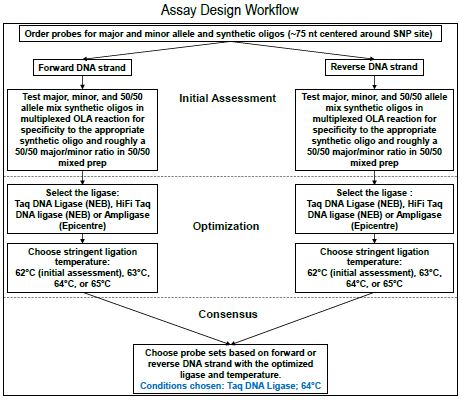
Optimized Protocol
- Perform OLA on synthetic oligos with multiplexed probe sets and Taq DNA Ligase (2 min at 95 °C and 30 cycles of 30 sec at 95 °C and 2 min at 64 °C). Block N-PLEX plate for 30 min at 37 °C during OLA cycling.
- Wash the plate and add OLA product in hybridization buffer (50 µL per well) to the plate. Incubate for 1 hr. at 37 °C.
- Wash the plate and add detection solution (50 µL per well). Incubate 30 min at 37 °C.
- Wash the plate and add read buffer (150 µL per well). Analyze with MSD instrument.
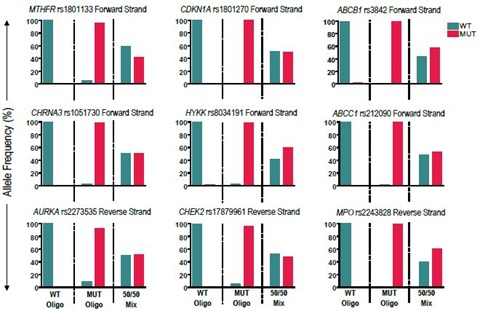
Synthetic oligo templates show high specificity for the appropriate allele using the optimized ligase and temperature conditions of Taq DNA ligase and 64 °C, respectively. WT= Wild-type (major allele), MUT = Mutant (minor allele). All nine assays fit well within our allele frequency guidelines for calling SNPs: Homozygous > 80%, Heterozygous = 30-70%, and Not Present < 20%.
5. Results – Sample Testing
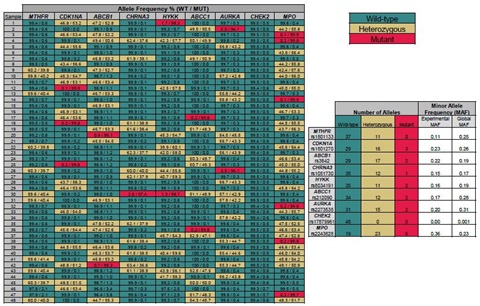
Using optimized protocol with multiplexed PCR products, genotyping of 48 samples was carried out in duplicate for all 9 SNP assays on 2 panels. Experimental results were compared with global minor allele frequencies. SNP calls were obtained for all 48 samples for the nine assay set.
6. Results – Robustness Testing
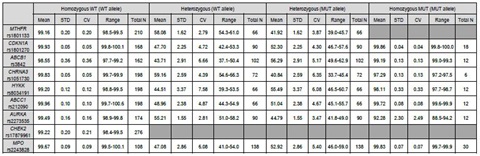
Genotyping on a total of 46 samples was completed by three different operators to determine robustness of each assay. Operators performed individual multiplexed PCR reactions, individual OLA reactions, and individual N-PLEX measurements. There was 100% concordance in genotyping results between all 3 operators in the sample set.
7. Results – Genotyping Comparison
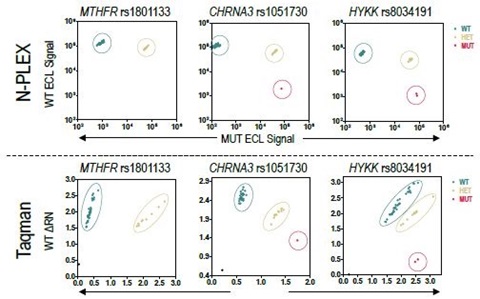
Protocol
- The following Taqman SNP Genotyping Assays were used : MTHFR rs1801133 (C__12028833_20) CHRNA3 rs1051730 (C__9510307_20) HYKK rs8034191 (C___479126_10)
- Assays were run according to the manufacturer’s recommendations using an AB Step-One Plus qPCR machine.
- Results were compared with ECL signals generated from the N-PLEX assays for concordance and signal separation.
There was 100% concordance in genotyping results between N-PLEX and Taqman SNP Genotyping Assays. Signal differentials between the two alleles were more easily distinguishable with the N-PLEX readouts, with a couple of logs of separation between positive and negative signals.
8. Conclusions
The N-PLEX platform gives the flexibility to customize panels of SNP assays for a given sample set. Furthermore, OLA and N-PLEX can be run in a single workday, allowing up to 470 SNP calls per plate (including two negative control wells). Low reading times (~2 min.) greatly increase the number of SNPs that can be assessed per day. These data indicate that the N-PLEX platform is an excellent alternative to currently available technologies for SNP determination that allows for high-throughput allelic assignment in a highly-reproducible multiplexed format.