2. MSD Technology
The Meso Scale Discovery (MSD) ECL detection technology uses SULFO-TAG labels that emit light upon electrochemical stimulation initiated at the electrode surfaces of MULTI-ARRAY and MULTI-SPOT microplates.
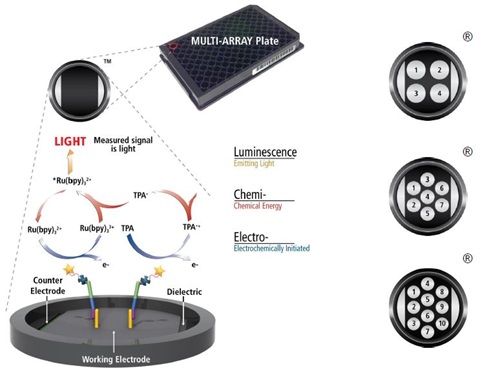
Electrochemiluminescence Technology
- Minimal non-specific background and strong responses to analyte yield high signal-to-background ratios.
-
The stimulation mechanism (electricity) is decoupled from the response (light signal), minimizing matrix interference.
-
Only labels bound near the electrode surface are excited, enabling non-washed assays.
-
Labels are stable, non-radioactive, and directly conjugated to biological molecules. Emission at ~620 nm eliminates problems with color quenching.
-
Multiple rounds of label excitation and emission enhance light levels and improve sensitivity.
-
Carbon electrode surface has 10X greater binding capacity than polystyrene wells.
- Surface coatings can be customized.
N-PLEX platform:
N-PLEX plates contain up to 10 unique capture oligonucleotides that are bound to their corresponding spot on the electrode surface. Detection of a nucleic acid sequence of interest is accomplished by hybridization of one or more probes with complementary sequence to these capture oligos and the nucleic acid of interest, followed by detection via electrochemiluminescence. Blocking, hybridization, and detection are achieved using MSD proprietary buffers and diluents.
siRNA analyte:
The model therapeutic analyte is a 20-mer duplex siRNA, based on GTI-2040 (Lee et al., Cancer Res, 2003, PMID: 12782585) with the following sequence: antisense strand (AS): 5′-GGCTAAATCGCTCCACCAAG-3′ and sense strand (SS): 5’-CTTGGTGGAGCGATTTAGCC-3’
3. Results – siRNA detection using RNase protection assay
Singleplex detection of SS and AS strands of siRNA:
The RNase protection assay uses chimeric probes specific to either the SS or AS strands to detect siRNA on the N-PLEX platform. Singleplex assays were carried out in separate wells for the SS and AS strands. Chimeric probes contain a 5′ DNA sequence complementary to the N-PLEX plate-bound capture oligo followed by an RNA sequence complementary to the siRNA strand of interest (SS/AS), with a biotin at the 3′ end for detection via streptavidin (SA) bound to SULFO-TAG label. Once the probe was hybridized to the analyte and the plate, an RNase cocktail was added to degrade any single stranded RNA. Any RNA in the probe not fully protected by the siRNA strands is degraded, releasing biotin from the DNA portion of the probe, rendering it undetectable.
Optimized Protocol
- Naïve mouse plasma (BALB/c strain) was pre-treated with N-PLEX lysis buffer, and heated to 60°C for 10 minutes to inactivate endogenous RNases.
-
An 8-point calibration curve was generated by spiking siRNA into buffer or mouse plasma. siRNA was serially diluted 5-fold, starting from 4000 pM at the top of curve (TOC).
- SS/AS strands of siRNA were hybridized with their corresponding chimeric probe in PCR strips/plates at 1.25 nM concentration. Probes target Spot 1 for the AS strand and Spot 10 for the SS strand.
- During hybridization, the N-PLEX plate was blocked at 37°C for 30 mins.
- N-PLEX plate was washed, 50 µL of hybridized probe-analyte product was added to each well in duplicate. Plate was incubated at 30°C for 1 hr.
- Plate was washed, 50 µL per well of an RNase cocktail (RNase A + RNase T1) was added to degrade unbound probes. Plate was incubated at 30°C for 1 hr.
-
Plate was washed, detection solution was added (50 µL per well), and plate was incubated at room temperature for 30 mins.
-
Plate was washed, read buffer was added (150 µL per well), and plate was read using an MSD instrument.
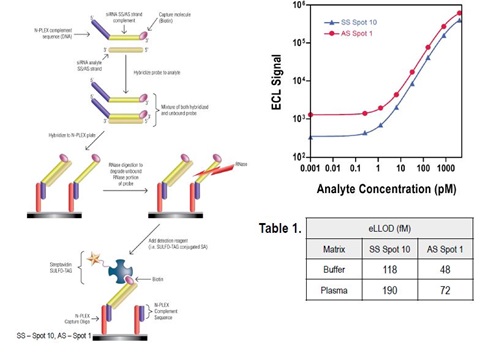
Figure 1. A calibration curve was generated using duplex siRNA, using capture probes specific to SS or AS strands, which were detected using an RNase protection assay on the N-PLEX platform (see schematic and protocol). Estimated lower limit of detection (eLLOD) for SS and AS in buffer and plasma are in Table 1.
4. Results – Shortened capture probes for multiplex detection
Design and test of shortened capture probes
- Chimeric capture probes were designed as in Figure 1, but serially shortened from the 3’ end by two or more nucleotides. Three shortened probes were designed for the SS and AS strands, respectively: 16-mer, 17- mer and 18-mer (Figure 2). SS probes target Spot 10, and AS probes target Spot 1.
- Shortened capture probes specific for SS or AS hybridize to their target strands with high stringency in a single well, instead of cross-hybridizing to each other.
-
Hybridized probe-analyte complexes are detected via RNase protection assay using ECL-based readout on an N-PLEX plate.
- Any residual probe-probe interactions are degraded by added RNases at the free single-stranded RNA sections not covered by the shortened probes. (Figure 3).
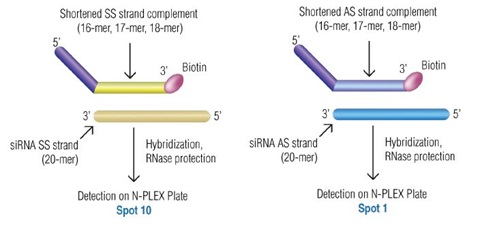
Figure 2. Shortened capture probes were designed for the SS and AS strands of duplex siRNA. Probes were serially shortened from the 3’ end by two or more nucleotides. siRNA strands were detected using RNase protection assay on the N-PLEX platform.
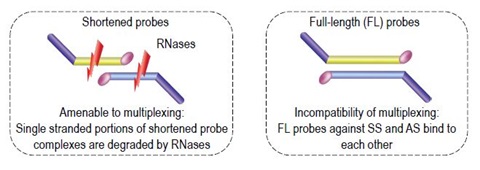
Figure 3. Shortened probes, specific to SS or AS strands, enable multiplexing in a single well. Cross-interactions between SS and AS probes are eliminated by RNase digestion, degrading unbound, single stranded RNA sections not protected by shortened probes. Full-length probes cannot be multiplexed as they form strong, RNase-resistant probe-probe interactions, leading to high, false-positive background signals.
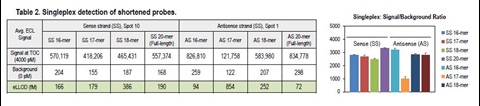
Figure 4. Shortened probes enable ultrasensitive detection in singleplex format. eLLODs are in Table 2.
5. Results – Multiplexed detection in a single well
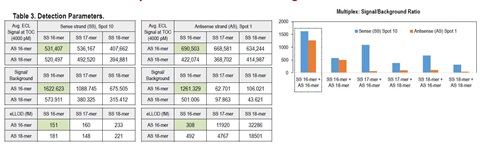
Figure 5. Shortened probes were multiplexed in combinations, in a single well, to simultaneously detect both siRNA strands. The SS 16-mer + AS 16-mer probe combination was chosen for further experiments based on detection criteria in Table 3 (highest signal-to-background ratio, lowest eLLOD).
6. Results – Dilution Linearity in Mouse Plasma
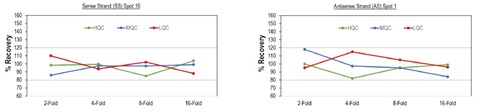
Figure 6. Mouse plasma was diluted 2-, 4-, 8-, and 16-fold in buffer, and siRNA calibrator was spiked into diluted plasma at three concentrations: high quality control (HQC) of 600 pM, medium quality control (MQC) of 60 pM and low quality control (LQC) of 6 pM. An SS 16-mer and AS 16-mer probe mix was used for multiplex detection of SS and AS. The assay shows excellent linearity of dilution throughout the dynamic range.
7. Results – Spike Recovery in Mouse Plasma
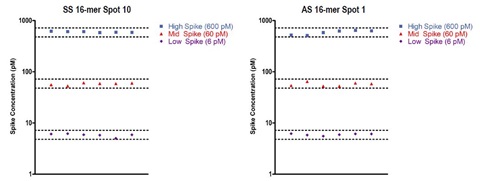
Figure 7. siRNA calibrator was spiked into mouse plasma at three concentrations. An SS 16-mer and AS 16-mer probe mix was used for multiplex detection of SS and AS. The percent recovery fell within acceptable guidelines of 100 ± 20%.
8. Results – Matrix Testing in Mouse Liver and Brain Lysate
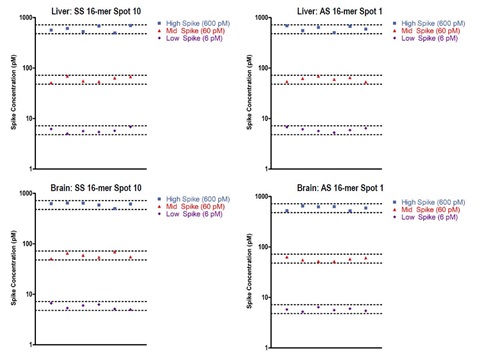
Figure 8. Mouse liver and brain tissue (BALB/c strain) were homogenized in N-PLEX lysis buffer using a bead mill homogenizer. Liver and brain are primary target organs for siRNA therapeutics. Tissue lysate was diluted 1:100 in buffer and siRNA calibrator was spiked in at three concentrations. An SS 16-mer and AS 16-mer probe mix was used for multiplex detection of SS and AS. The percent recovery fell within acceptable guidelines of 100 ± 20%.
9. Results – Reproducibility Testing
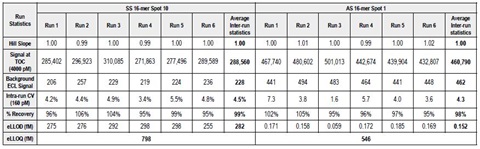
Table 4. Multiplex assays were run in mouse plasma for 3 consecutive days (2 runs per day), with highly reproducible results.
10. Conclusions
- By combining multiplexed detection of SS and AS strands of siRNA with ultrasensitive ECL detection, this approach represents a significant advancement in siRNA analysis techniques for pharmacokinetic studies.
- With the observed femtomolar sensitivity, we achieved >1000-fold improvement in detection compared to other technologies like LC-TOF-MS and LC-MS/MS (Ramanathan and Shen, Bioanalysis, 2019, PMID: 31829057; Yuan et al., Molecules, 2023, PMID: 36838605).
- Through enabling detection of both strands of siRNA within a single reaction with unrivaled sensitivity, our approach paves the way for a deeper understanding of siRNA drug metabolism, distribution and elimination, and promises to accelerate the translation of siRNA therapeutics.